Sunk Cost Fallacy
Continuing to invest in something because of what you've already put in, not because of what you'll get out.
Also known as throwing good money after bad · the Concorde fallacy · escalation of commitment
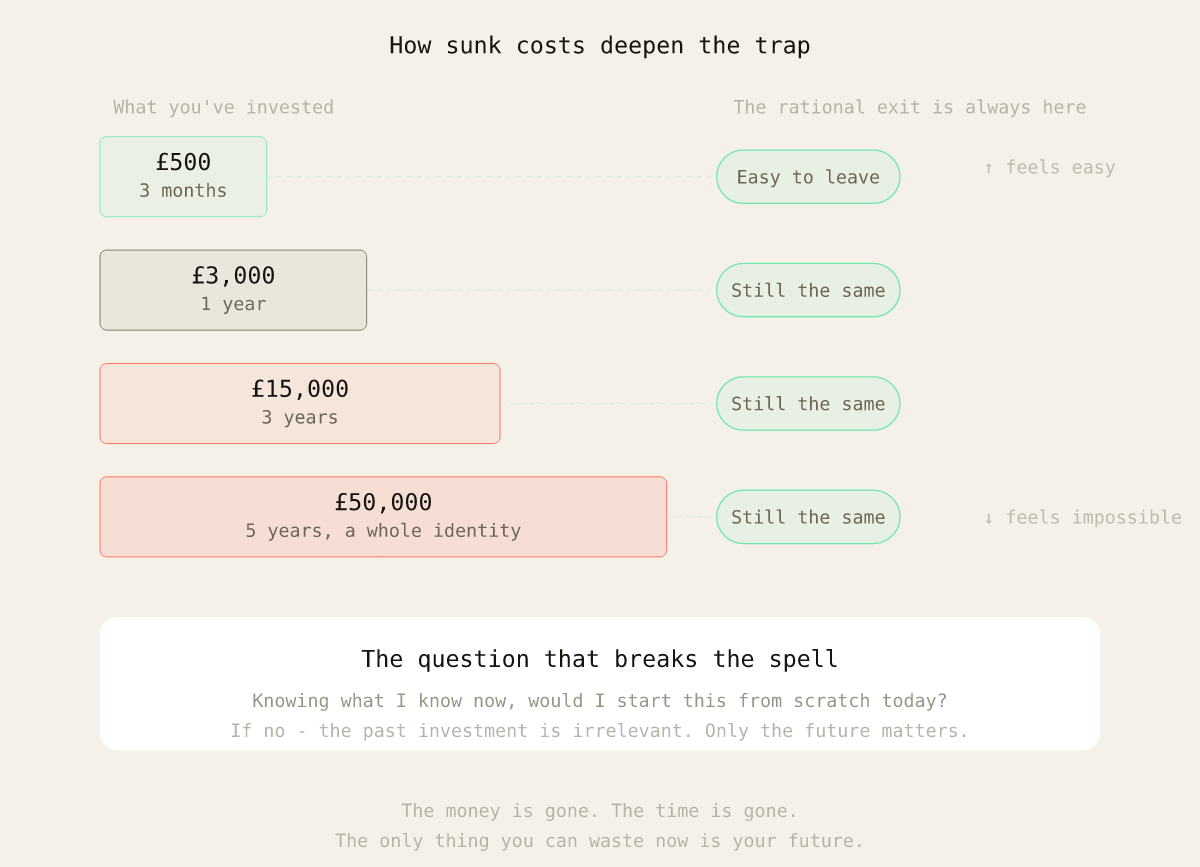
What the sunk cost fallacy means
The sunk cost fallacy is the tendency to continue investing time, money, or effort into something because of what you’ve already invested, rather than based on future returns. The past investment - the sunk cost - is gone regardless of what you do next. Rationally, it shouldn’t factor into your decision at all. But it almost always does.
The pull is powerful because walking away feels like waste. If you leave a terrible film after an hour, that’s an hour lost. But staying for another hour doesn’t get the first hour back - it just loses you a second one. The sunk cost creates an emotional gravity that keeps you locked in, even when the rational move is to cut your losses.
This isn’t just about money. We do it with relationships, careers, projects, arguments, and beliefs. The more we’ve invested in something, the harder it becomes to admit it isn’t working - because that admission carries the weight of everything we’ve already put in.
Why the sunk cost fallacy is so hard to resist
The sunk cost fallacy persists because it’s tangled up with several other psychological forces that all pull in the same direction.
Loss aversion makes walking away feel like losing twice
Loss aversion - our tendency to feel losses more intensely than equivalent gains - is the emotional fuel behind sunk costs. First described by psychologists Daniel Kahneman and Amos Tversky in the late 1970s, it’s one of the most robust findings in behavioural economics. Walking away doesn’t just mean accepting that the future won’t pay off. It means accepting that everything you already invested is gone for nothing. That feels like a loss on top of a loss, and our brains are wired to avoid that feeling at almost any cost.
This is why people will drive across town to use a voucher worth a few pounds but won’t walk away from a failing project worth thousands. The voucher feels like a gain. The project feels like a loss. The psychology doesn’t scale with the numbers. And even on the rare occasions when you do see the project through, the arrival fallacy is waiting: the satisfaction you were chasing turns out to be a smaller, quieter thing than the cost suggested it would be.
Admitting you were wrong triggers cognitive dissonance
There’s an identity cost to quitting. Walking away from a sunk cost means admitting that the original decision - the one you made, possibly publicly, possibly enthusiastically - was wrong. That creates cognitive dissonance: the uncomfortable tension between “I’m a smart person who makes good decisions” and “this decision was a mistake.”
Rather than sit with that discomfort, we find ways to justify continuing. We tell ourselves the situation will improve, that the investment is about to pay off, that quitting now would be premature. This is motivated reasoning at work - using our intelligence to defend a conclusion we’ve already reached, rather than to evaluate the situation honestly.
Confirmation bias keeps the trap invisible
Once you’re invested, confirmation bias quietly takes over. You notice the small signs of progress and overlook the larger signs of failure. A project delivers one minor milestone and everyone points to it as proof the approach is working, while the missed deadlines and budget overruns get explained away. The deeper the investment, the more selectively you process new information about whether it’s worth continuing.
The sunk cost fallacy in everyday life
The Concorde supersonic jet is the classic case - so much so that economists sometimes call this the “Concorde fallacy.” The British and French governments continued funding the project long after it became clear it would never be commercially viable. The reasoning was always about the money already spent, never about the money still to come. Billions poured in because billions had already been poured in.
Sunk costs in relationships and personal decisions
In everyday life, it’s the gym membership you keep paying for because you paid the joining fee. The degree you finish even though you realised in year two it’s the wrong subject. The relationship you stay in because you’ve already given it five years - as if those five years would somehow be restored by giving it five more.
What makes these personal sunk costs so sticky is that they’re wrapped up in our sense of identity. Leaving a career you’ve spent a decade building doesn’t just feel like losing ten years - it feels like losing the version of yourself who made that choice. The cost isn’t just time. It’s meaning. And that makes it much harder to write off.
Sunk costs in the workplace
In the workplace, it’s the project everyone knows is failing but nobody will cancel because “we’ve come this far.” The further in you are, the harder it becomes to stop - which means the worst projects, the ones that should have been killed earliest, often run the longest.
This gets worse when the sunk cost involves public commitment. A CEO who announced a new strategy at a shareholder meeting has their reputation invested alongside the company’s money. Cancelling the strategy means admitting the announcement was wrong. So the strategy continues, not because the evidence supports it, but because the framing effect has shifted the question from “is this working?” to “can we justify what we’ve already spent?”
Sunk costs in politics and public spending
At the level of governments and institutions, the sunk cost fallacy can be catastrophic. Wars continue because of the lives already lost - as if more deaths could retroactively justify the earlier ones. The Vietnam War is often cited as a defining example: escalating military commitment year after year, driven not by realistic prospects of victory but by the political impossibility of admitting that the lives and resources already spent had been spent in vain. Infrastructure projects spiral in cost because cancellation would mean “wasting” the billions already spent, even when completion will cost billions more for something nobody needs.
The pattern is always the same. The language of “protecting our investment” replaces the language of “is this the best use of what we have left?” And the bigger the sunk cost, the more unthinkable it becomes to walk away from it.
How to think clearly about sunk costs
The antidote to the sunk cost fallacy is a deceptively simple question: knowing everything I know now, would I start this today? If the answer is no, then continuing is not “protecting your investment.” It’s making the same mistake twice.
This is closely related to opportunity cost - the idea that every resource you spend on one thing is a resource you can’t spend on something else. The time you spend finishing a book you’re not enjoying is time you can’t spend on one you would. The money you pour into a failing project is money that could fund a better one. Sunk costs are invisible to the future, but opportunity costs are not.
It also helps to apply inversion - instead of asking “should I keep going?”, ask “if I weren’t already doing this, would I choose to start?” Inverting the question strips away the emotional weight of what’s already been spent and forces you to evaluate the decision on its own merits.
None of this is easy. The sunk cost fallacy isn’t a failure of intelligence. It’s a failure of emotion management, identity management, and institutional incentives all pulling in the same direction. The smartest people fall for it. The best organisations fall for it. Knowing about it is the first step, but the real work is building the habit of asking the right question - not “how much have I spent?” but “what’s the best thing I can do from here?”
How to spot it
When you catch yourself saying 'but I've already spent so much time/money/effort on this', pause. That's the sunk cost talking. The only question that matters is: knowing what I know now, would I start this from scratch today?
A thought to hold onto
The money is gone. The time is gone. The only thing you can waste now is your future.
Why it matters now
From governments doubling down on failing policies to individuals staying in jobs, relationships, or subscriptions long past the point of return, the sunk cost fallacy shapes decisions at every scale. In an economy built on auto-renewals and long-term commitments, learning to walk away from past investment is a survival skill.