Straw Man
Misrepresenting someone's argument to make it easier to attack.
Also known as Straw man fallacy · Straw man argument · Aunt Sally
What a straw man argument is
A straw man argument is when someone distorts another person’s position into something weaker or more extreme, and then attacks the distortion instead of engaging with the real argument. The name comes from the image of a straw training dummy - something built specifically to be knocked down easily.
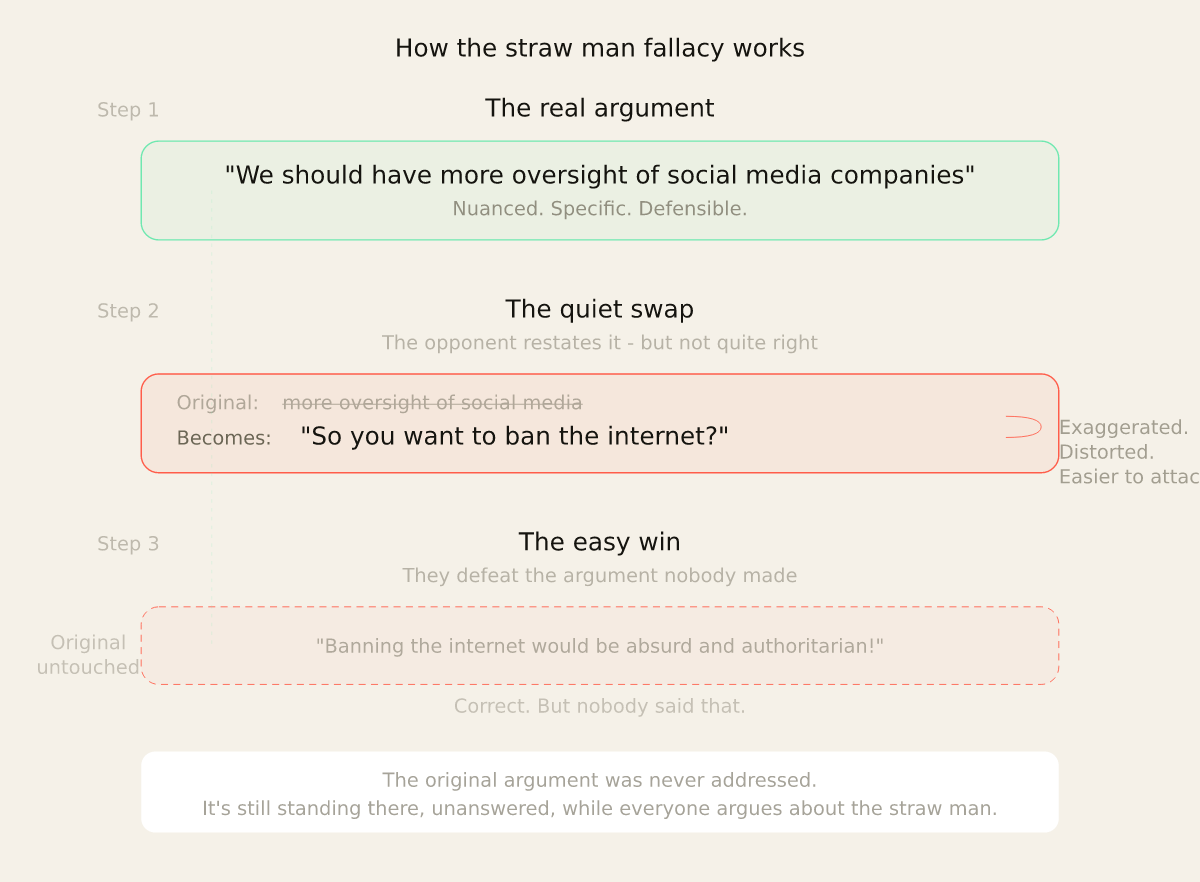
The move has three steps. First, someone makes a genuine argument. Second, their opponent quietly replaces it with a different, flimsier version. Third, the opponent attacks the flimsier version and claims victory. The audience often doesn’t notice the substitution, because the response has the shape and rhythm of a real rebuttal. It sounds like engagement. But it isn’t - it’s a performance of engagement directed at something nobody said.
What makes the straw man so effective is that it works on both the audience and the person using it. A skilled debater might deploy it deliberately. But many people create straw men without realising it, because they’ve genuinely misunderstood the other side - or because they’ve only encountered a caricatured version of the position in the first place. Straw man arguments often arrive packaged as a loaded question - the misrepresentation is folded into the question’s structure, so the target has to accept the distortion just to begin answering.
How the straw man fallacy works
The distortion can take several forms, and recognising them is the first step to spotting a straw man in the wild.
Exaggeration
A moderate position gets inflated into an extreme one. “We should consider reducing military spending” becomes “You want to leave us completely defenceless.” “Perhaps we could look at how we teach history” becomes “You want to erase our heritage.” The original claim gets stretched until it sounds unreasonable, and then the stretched version is what gets attacked.
Oversimplification
A nuanced position gets reduced to its crudest possible form. Someone argues that social media platforms should take more responsibility for the content they amplify, and the response treats them as if they’ve called for the abolition of free speech. The complexity vanishes. What remains is a cartoon that’s easy to defeat - and that’s the point.
Selective quoting
A single phrase gets pulled from a longer argument and treated as if it were the whole thing. This is especially common in media coverage and on social media, where a sentence lifted from context can be made to mean almost anything. The person wasn’t wrong about what they quoted - they were wrong about what the argument was.
Fabrication
Sometimes the substitution isn’t subtle at all. Someone simply invents a position their opponent never held and argues against that instead. “My opponent believes we should just let criminals walk free.” Did they say that? Almost certainly not. But the fabricated version is more outrageous, more shareable, and more likely to provoke a reaction. This form of the straw man is particularly common in election campaigns, where candidates routinely attribute positions to their opponents that no one has advocated, knowing that the denial rarely travels as far as the accusation.
Straw man arguments in politics and media
Political debate runs on straw men. It’s one of the most common logical fallacies in public discourse, alongside ad hominem attacks and whataboutism. The reason is simple: engaging with a nuanced policy position is difficult and boring. Engaging with a caricature is easy and dramatic.
“We should have a conversation about immigration policy” gets reframed as “they want open borders.” “We should consider the economic impact of this regulation” becomes “they care more about money than people.” Each time, a position that might require careful thought to rebut gets replaced with one that requires only outrage. The philosopher Aristotle identified this move in his work on rhetoric over two thousand years ago, and it hasn’t become any less effective since.
In news media, the straw man often works through framing. A headline might accurately quote a phrase while completely misrepresenting the argument it came from. The reader encounters the distorted version first, forms an opinion, and may never go back to check what was originally said.
Straw man arguments on social media
Social media has given the straw man its ideal habitat. Character limits compress nuanced positions into fragments. Quote tweets let people reframe someone’s words before their audience ever sees the original. Screenshots strip context entirely.
The incentive structure makes it worse. A nuanced position takes 500 words to express. A straw man version takes 20 - and gets more likes, more shares, and more engagement. Platforms reward the distortion because outrage performs better than accuracy. The person building the straw man may not even know they’re doing it; they may have only ever encountered the caricatured version of the position, passed from account to account like a game of telephone.
A common pattern is the “screenshot dunk.” Someone posts a long, qualified thread. A quote-tweeter screenshots a single line, strips it from its surrounding caveats, and pairs it with a one-word verdict. The audience for the dunk vastly outnumbers the audience for the original thread, so the caricature becomes the version that travels. By the time the original author replies with “that’s not what I said,” the conversation has already moved on, and the correction sits at a tenth of the original engagement. The straw man wins not by being more persuasive but by being more shareable - and on a platform where shareability is the only currency, that’s the same thing as winning.
This connects to what Moresapien calls loaded language - the words chosen to describe the distorted position carry emotional weight that the original didn’t. “Concerned about housing costs” becomes “anti-development.” “Questioning a policy” becomes “attacking.” The substitution isn’t just conceptual; it’s linguistic.
The straw man and other fallacies
The straw man rarely works alone. It’s often the first move in a sequence that includes other distortions.
A common pairing is the straw man with a false dilemma. First, misrepresent the opposing position. Then present a false choice between that distorted version and your own. “Either we accept their reckless plan or we go with common sense.” The audience is left choosing between a caricature and a reasonable-sounding alternative - which was the point all along.
The motte-and-bailey is sometimes described as the straw man’s mirror image. Where a straw man distorts someone else’s position, a motte-and-bailey distorts your own - making a bold claim and then retreating to a more defensible one when challenged. Both depend on the audience not noticing the switch.
It’s also worth distinguishing the straw man from tone policing, where the focus shifts from what someone said to how they said it. And from concern trolling, where the appearance of engaging with an argument masks the fact that the engagement is entirely performative.
How to counter a straw man argument
When you suspect someone has straw-manned your position, the most effective response is to restate your actual argument clearly and calmly. “That’s not what I said. What I said was…” This forces the conversation back to the real position, and it makes the distortion visible.
In a public or online setting, it helps to name the move without being combative. “I notice you’re responding to a version of my argument I didn’t make.” This flags the tactic for onlookers without escalating the exchange into a personal conflict.
It is worth noting that not every misrepresentation is a deliberate straw man. Sometimes people genuinely mishear an argument, or they’ve absorbed a distorted version of a position through social proof - hearing it repeated so often in simplified form that they believe the simplification is the real thing. In those cases, a patient restatement is more productive than an accusation of bad faith.
The deeper challenge is recognising when you’re building a straw man yourself. We all do it - especially with positions we find frustrating or threatening. The test from psychology researcher Julia Galef’s work on scout mindset is useful here: can you describe the other side’s position in terms they would recognise and agree with? If not, you might be arguing against straw.
How to spot it
When someone responds to an argument, check whether they're addressing what was actually said or a distorted version of it. If you find yourself thinking 'that's not what they meant,' you're probably looking at a straw man. The clearest test: could the original speaker hear the rebuttal and say 'yes, that's a fair representation of my view'? If not, the argument has been quietly swapped out.
A thought to hold onto
If someone can only defeat a twisted version of your argument, they haven't defeated your argument at all.
Why it matters now
In an era of screenshots, quote tweets, and character limits, arguments are routinely stripped of their nuance before being passed around. The straw man has never had better infrastructure.